01The challenge
Running a business through a personal bank account.
Freelancers and small businesses in the Gulf faced obstacles to opening business bank accounts. The founders of Xpence had experienced the problem themselves. For newly incorporated businesses in the UAE, account requirements could include a deposit or minimum balance of AED 25,000-50,000.
The consequences reached beyond the account application. Owners used personal accounts for business expenses, tracked employee spending manually, and dealt with petty cash, missing receipts, and difficult reconciliation. Affordable invoicing and payment options were another gap.
The design opportunity was to connect access to business spending with the everyday work of managing it. A corporate card, clear expense information, and usable controls needed to work together for a small company with limited time and resources.
02My role & team
Build design capability while staying close to the product.
As Head of UX, I was responsible for user research, end-to-end product design, design-team hiring and leadership, and developer handoff. I built a remote team of two UX designers and one visual designer, working closely with the product manager and the leadership team, including the CEO and CTO.
The role required both direction and delivery. I helped shape the account journeys, product scope, and design system while working through the detailed flows with the team. Research and design decisions stayed connected to technical feasibility and the business’s changing proposition.
The remote staffing approach reduced design staffing costs by 70%. It also brought a leadership lesson: low cost alone did not guarantee the depth of ownership a young product needed. That became a significant part of our reflection after launch.
03Research
Validate the banking problem before defining the MVP.
We began with an online survey connected to Xpence’s coming-soon campaign. It received 216 unique customer responses and explored account-opening limitations, setup complexity, and financial constraints. The aim was to test the early assumptions about freelancers and SMEs before committing to a product scope.
The survey also helped us recruit people for interviews and usability studies. Meeting customers in person and over video let us understand how they handled spending, what they worked around, and what they expected from a business financial product.
We translated those frustrations and workflows into “How might we” questions. This gave the team a shared way to connect a proposed feature to a customer problem, and to discuss whether it justified a place in the first release.
 View full size
04The product pivot
A viable first product inside a larger financial ambition.
Xpence initially aimed to become a neobank for the UAE. Regulatory challenges around a banking licence and BIN sponsorship changed what the company could deliver. The proposition pivoted towards business expense management.
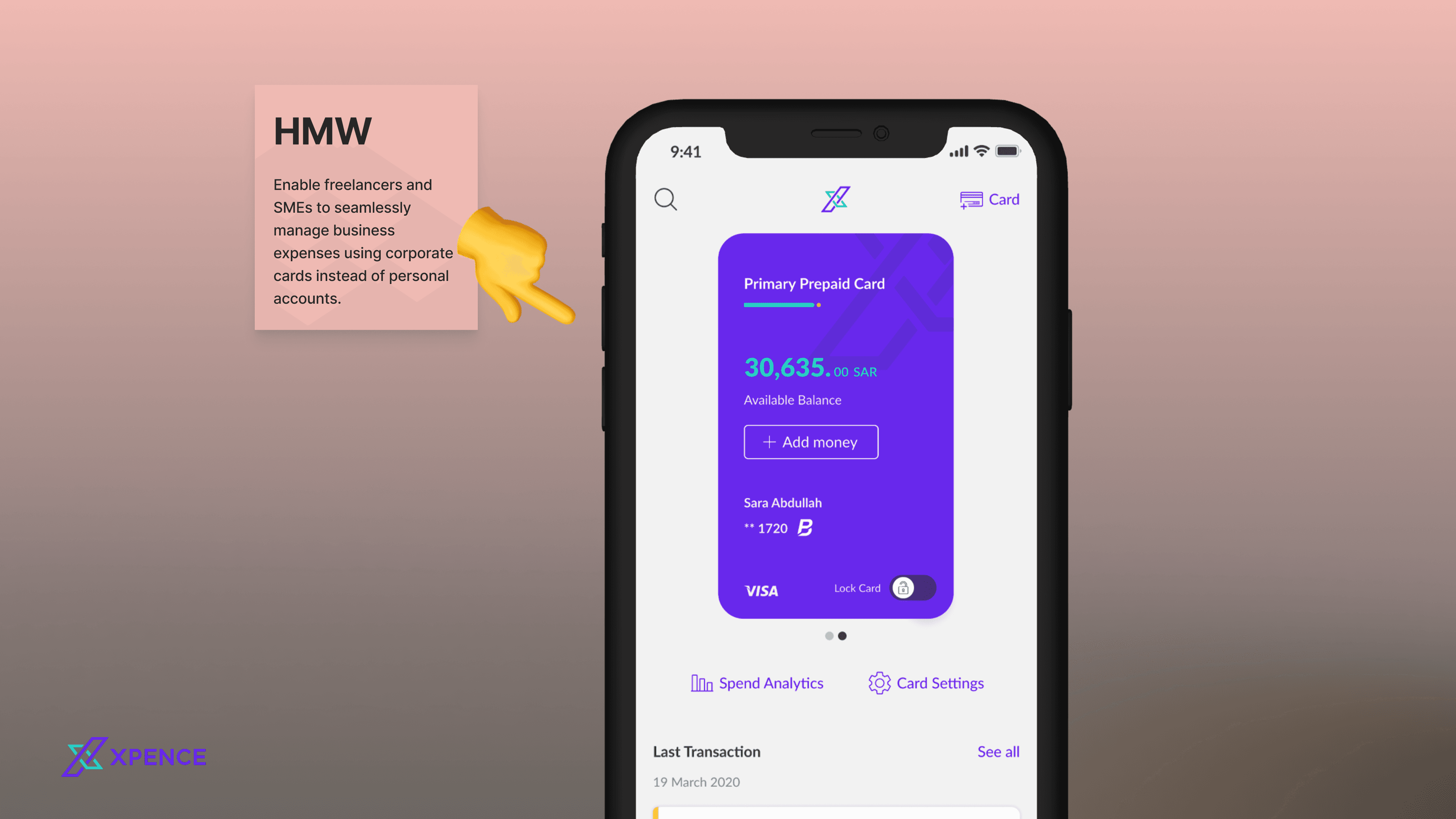
After assessing user needs, frustrations, and technical constraints, we aligned with leadership on physical prepaid cards for business owners as the most viable first step. An impact-effort matrix helped prioritise a phased rollout. Invoicing, payment gateways, and team cards were planned for subsequent stages.
The constraints were concrete. Automatically retrieving company information from government registers, for example, depended on internal APIs and approvals that could delay launch. The team had to distinguish a useful future improvement from a dependency that would prevent the first product reaching customers.
 View full size
05Design decisions
Prioritise the work a business owner needs to do every day.
We worked through multiple ideation sessions, more than four scope and design iterations, and over twenty usability studies. The product direction connected the immediate ability to spend with the less visible work of tracking and reconciling that spending.
Make the card and available balance immediately useful
The card-first dashboard placed available funds and core card actions at the centre of the experience. It gave the product a practical starting point for a business owner who needed to use it day to day.
Connect an expense to its supporting detail
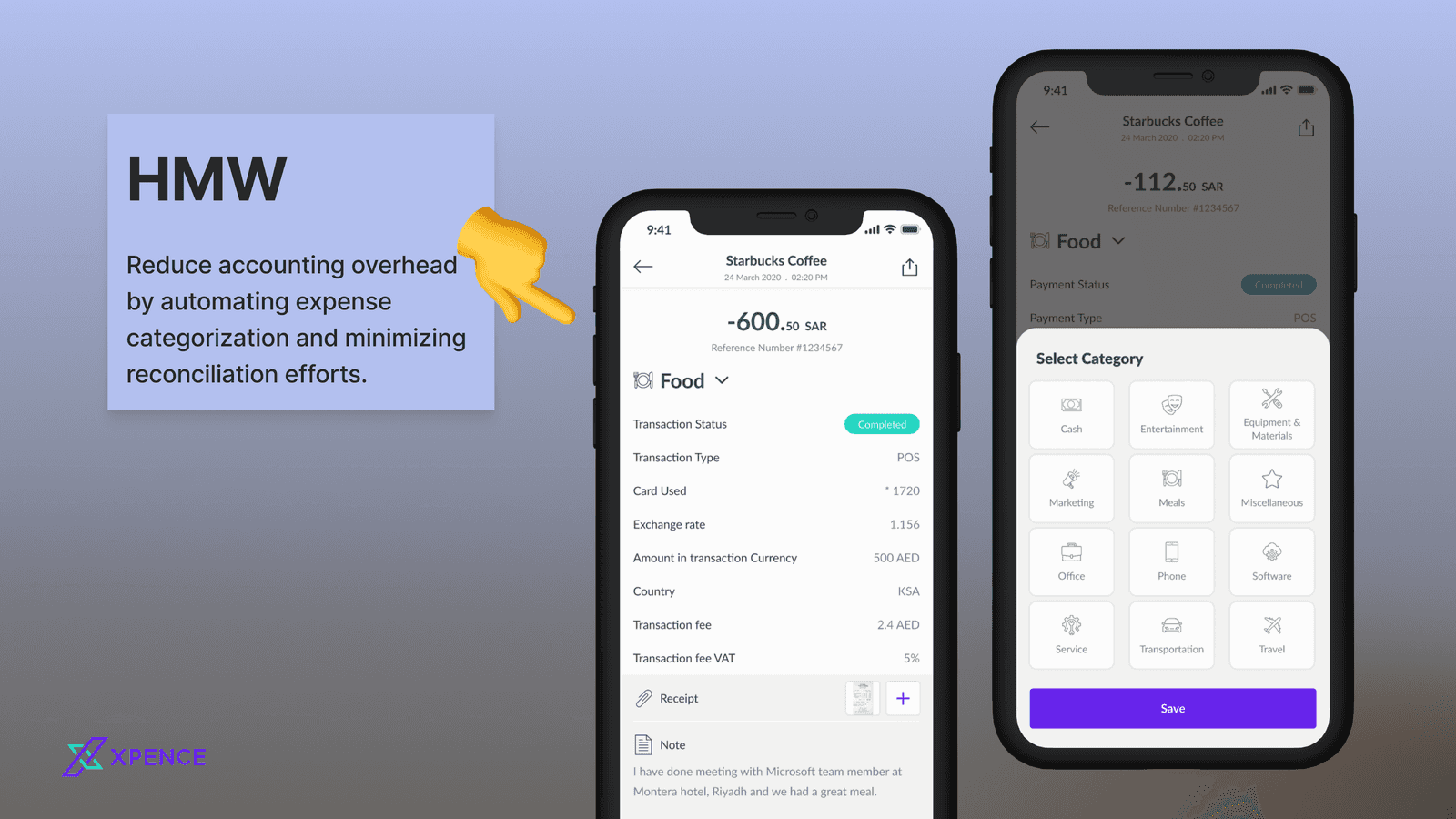
Transaction details, categorisation, and receipt capture addressed the work that normally followed a payment. This helped connect spending with the information needed for later reconciliation.
Make spend patterns visible
Category breakdowns and transaction activity gave owners a view beyond individual payments. Analytics sat within the spending experience rather than requiring a separate manual reporting workflow.
Establish patterns that can support the region
The design system included right-to-left support and reusable product patterns. Shared foundations mattered as the team worked across journeys and the business prepared to serve more markets.
06What we delivered
A mobile product with a clear centre of gravity.
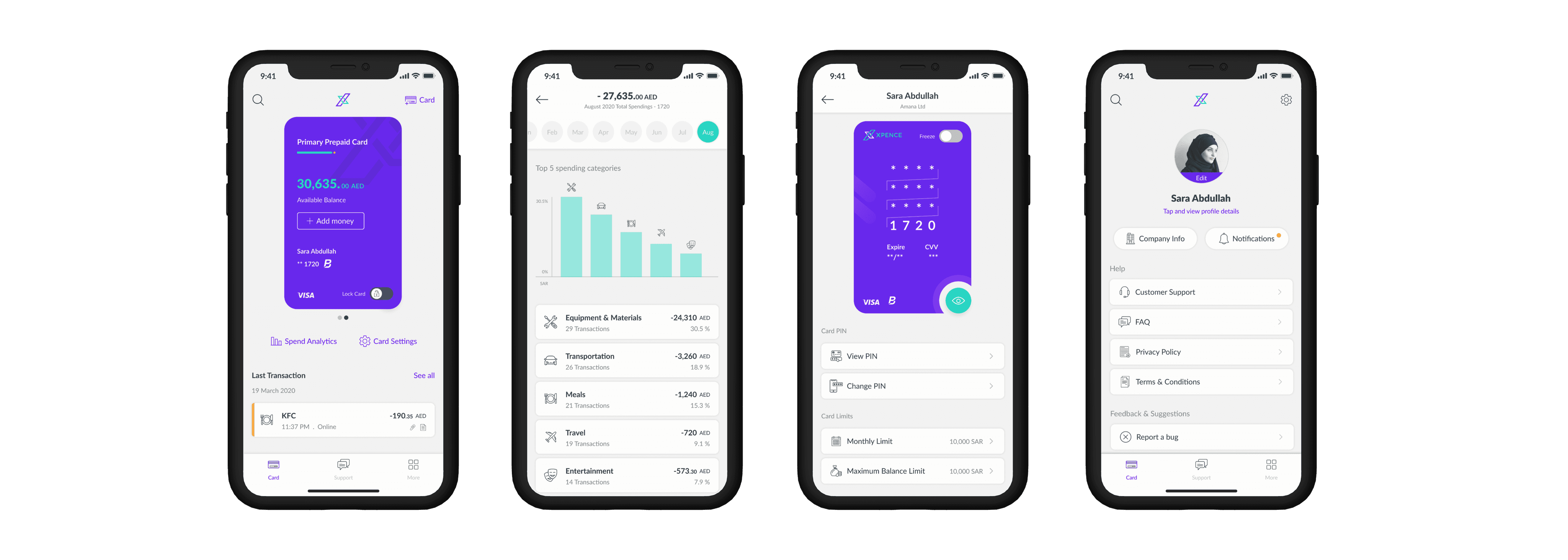
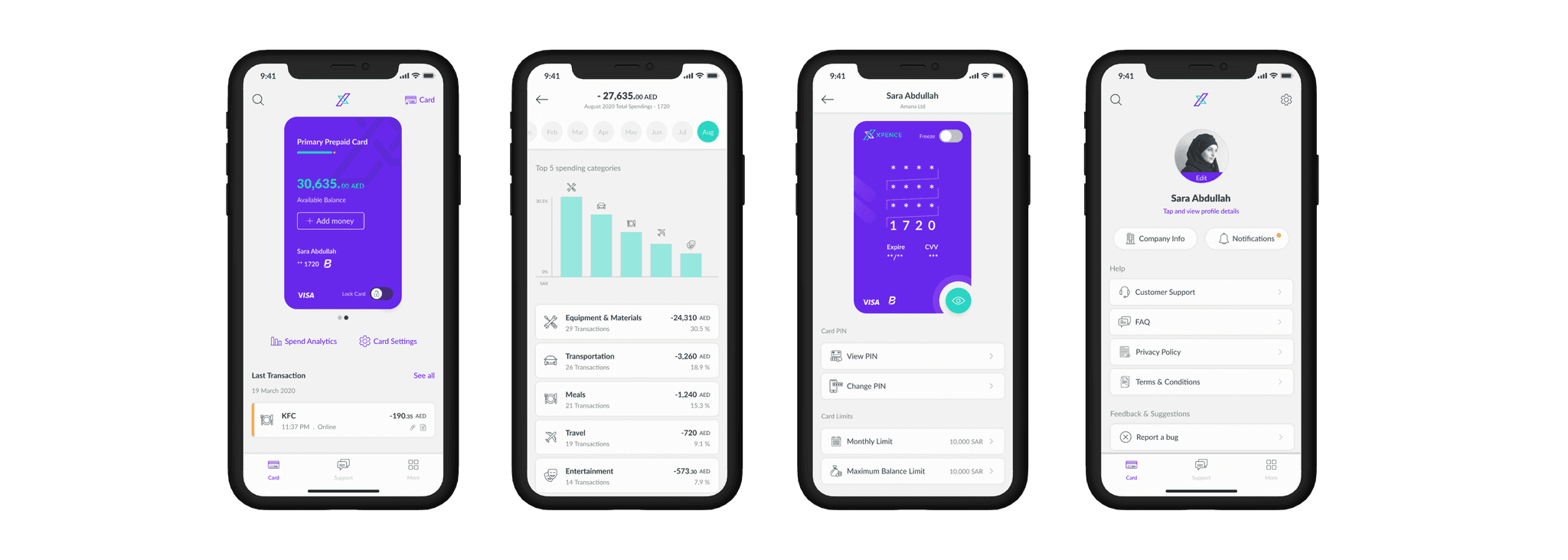
The launch product focused on corporate prepaid cards and business-spend management on iOS and Android. The original project screens show the card dashboard, spend analytics, card issuance, and transaction details with expense categorisation and receipt capture.
The interface detail served the product direction: understand the available balance, access the card, see where money is going, and keep the supporting information close to each transaction. We phased delivery around a focused card MVP. After that MVP succeeded, I led design with my team for invoicing and team modules, which launched during my tenure.
 View full size
 View full size
07Launch & impact
From a waitlist to a working business-spend product.
The MVP onboarded twenty customers from the waitlist and launched on the iOS App Store and Google Play. The business secured early funding from private angel investors, with the design work helping make the product proposition concrete.
My team’s delivery extended beyond the card MVP: invoicing and team modules also launched before I left Xpence. The product’s later expansion into markets including Saudi Arabia, Bahrain, and Egypt belongs to its wider journey, separate from my tenure.
For me, the important result was bringing customer research, a feasible commercial proposition, detailed design, and a functioning team together to reach launch. The regulatory pivot made that alignment essential.
08Leadership lessons
Ownership and context matter as much as the first release.
Two lessons from the original project continue to shape how I approach early-stage products and design teams.
Build deep product ownership into the team
Limited budgets initially led us to source designers through agencies in India and Pakistan. The approach gave us capacity, but gaps in deep product ownership and iteration speed showed why an in-house team mattered for alignment and a stronger shared product vision.
Design for where the work actually happens
Xpence launched mobile-first, but customers were often managing expenses at a desk. The business later launched a web version in 2022. That evolution underlined the need to validate the working context as carefully as the feature requirements.